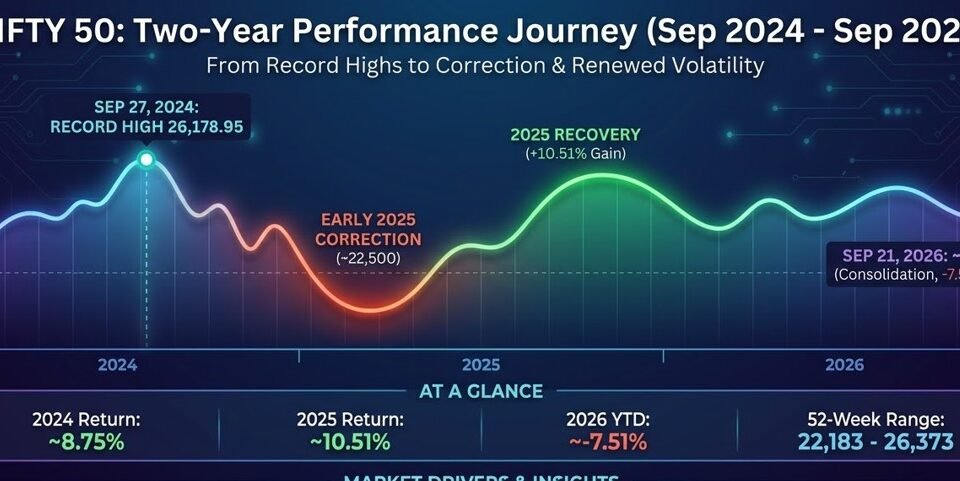

The NIFTY 50, India’s leading large-cap stock market index, has experienced a highly volatile two-year period, marked by a record high in September 2024, subsequent corrections, a recovery during 2025, and renewed consolidation in 2026.
As of September 21, 2026, the NIFTY 50 was trading around 23,414, compared with its record closing level of 26,178.95 on September 27, 2024. This represents a significant decline from the 2024 peak, although the index has also experienced substantial movements in both directions during the intervening period.
NIFTY 50: Two-Year Performance at a Glance
| Period / Indicator | NIFTY 50 Performance |
| September 27, 2024 record high | 26,178.95 |
| September 21, 2026 level | 23,414 |
| Change from September 2024 peak | Significant decline |
| 2024 calendar-year return | 8.75% |
| 2025 calendar-year return | 10.51% |
| 2026 YTD performance | Approximately -7.51% |
| 52-week high | 26,373.20 |
| 52-week low | 22,182.55 |
Market figures can change during trading hours. Historical returns and index levels should be verified against the relevant NSE closing data before publication.
2024: NIFTY 50 Reaches a Record High
The NIFTY 50 entered the final quarter of 2024 after a strong market run. On September 27, 2024, the index reached an all-time high of 26,178.95.
Strong corporate earnings expectations, economic growth, domestic investment and positive market sentiment contributed to the strong performance of Indian equities during this period.
The index subsequently moved into a period of increased volatility as investors reassessed valuations and the broader economic environment.
2025: Correction Followed by Recovery
The beginning of 2025 brought increased volatility to the Indian equity market. The NIFTY 50 moved lower during the early part of the year, with the index approaching the 22,500 level in March 2025.
However, the market subsequently recovered. During the year, the NIFTY 50 regained significant ground and moved back toward the 26,000 level.
Despite the volatility during the year, the index recorded an approximate 10.51% calendar-year gain in 2025, according to the figures referenced in the original analysis.
This period demonstrates an important characteristic of equity markets: a significant correction can be followed by a substantial recovery within the same market cycle.
2026: Consolidation and Renewed Volatility
The market environment changed again during 2026. After the recovery seen during 2025, the NIFTY 50 faced renewed pressure from valuation considerations and changing global macroeconomic conditions.
By September 21, 2026, the index was trading around 23,414.
The index’s reported 52-week range of approximately 22,183 to 26,373 illustrates the extent of volatility during the period.
What Has Driven the Market?
Several factors can influence the performance of the NIFTY 50 over a period such as this:
1. Corporate Earnings
The earnings growth of major NIFTY 50 companies is an important driver of index performance. Strong earnings can support valuations, while weaker-than-expected earnings can create pressure on stock prices.
2. Market Valuations
When equity valuations become elevated, investors may become more sensitive to earnings growth, interest rates and economic expectations.
3. Global Economic Conditions
Indian equities are also influenced by global developments, including interest-rate expectations, commodity prices, foreign institutional investment flows and international economic growth.
4. Domestic Economic Growth
India’s economic growth, infrastructure spending, consumption and corporate investment remain important factors affecting the long-term outlook for listed companies.
5. Investor Sentiment
Market sentiment can change rapidly. This can result in significant movements even when the underlying economic fundamentals change more gradually.
Two-Year Performance vs. Long-Term Perspective
Looking at only the movement from the September 2024 peak can give a different impression from looking at the broader history of the NIFTY 50.
The index has historically generated positive long-term returns over extended periods, although those returns have not been consistent from year to year. Investors have experienced periods of strong growth, corrections and extended consolidation.
Therefore, a two-year period should be viewed as one segment of a much longer market history rather than as a complete representation of the NIFTY 50’s long-term performance.
NIFTY 50: Key Takeaways
- The NIFTY 50 reached a record high of 26,178.95 on September 27, 2024.
- The index subsequently experienced a significant correction.
- During 2025, the market recovered substantially and recorded an approximately 10.51% calendar-year gain based on the figures referenced above.
- In 2026, the index experienced renewed volatility and traded around 23,414 on September 21, 2026.
- The market’s two-year movement highlights the difference between short-term market volatility and long-term equity performance.
- Investors should consider earnings, valuations, economic conditions and investment time horizon when evaluating index performance.
Conclusion
The last two years have been an important period for the NIFTY 50, taking the index from a record high in September 2024 through a correction, a recovery in 2025 and renewed volatility in 2026.
Rather than focusing on a single market level, investors and market observers can use this period to understand how Indian equities respond to changing earnings expectations, valuations, economic conditions and global market developments.
The NIFTY 50’s recent performance also demonstrates that short-term returns can differ substantially from long-term market trends. Historical performance, however, does not guarantee future returns.Disclaimer: This article is for educational and informational purposes only and should not be considered investment advice, a recommendation to buy or sell securities, or a prediction of future market performance. Investors should conduct their own research and consider their financial circumstances and risk tolerance before making investment decisions.

About The Author

